- LittleLaw
- Posts
- ⚖️ Why Vodafone's £85 million lawsuit might end before it starts
⚖️ Why Vodafone's £85 million lawsuit might end before it starts


Idin Sabahipour & Ahad Rahim
April 08, 2026

Together with

Table of Contents
If you take just one thing from this email...
62 Vodafone store owners are suing for £85 million, claiming they were treated unfairly when their contracts ended.
Rather than hear all 62 cases at once, the court is splitting the trial into two stages (and only testing 16 cases at first).
If Vodafone wins that first stage, the whole £85 million claim could disappear without ever going further.

EDITOR’S RAMBLE 🗣
Last week I asked whether you'd prefer 2 shorter newsletters or 1 longer one.
And the results are in – 87% of you voted for 2 shorter ones.
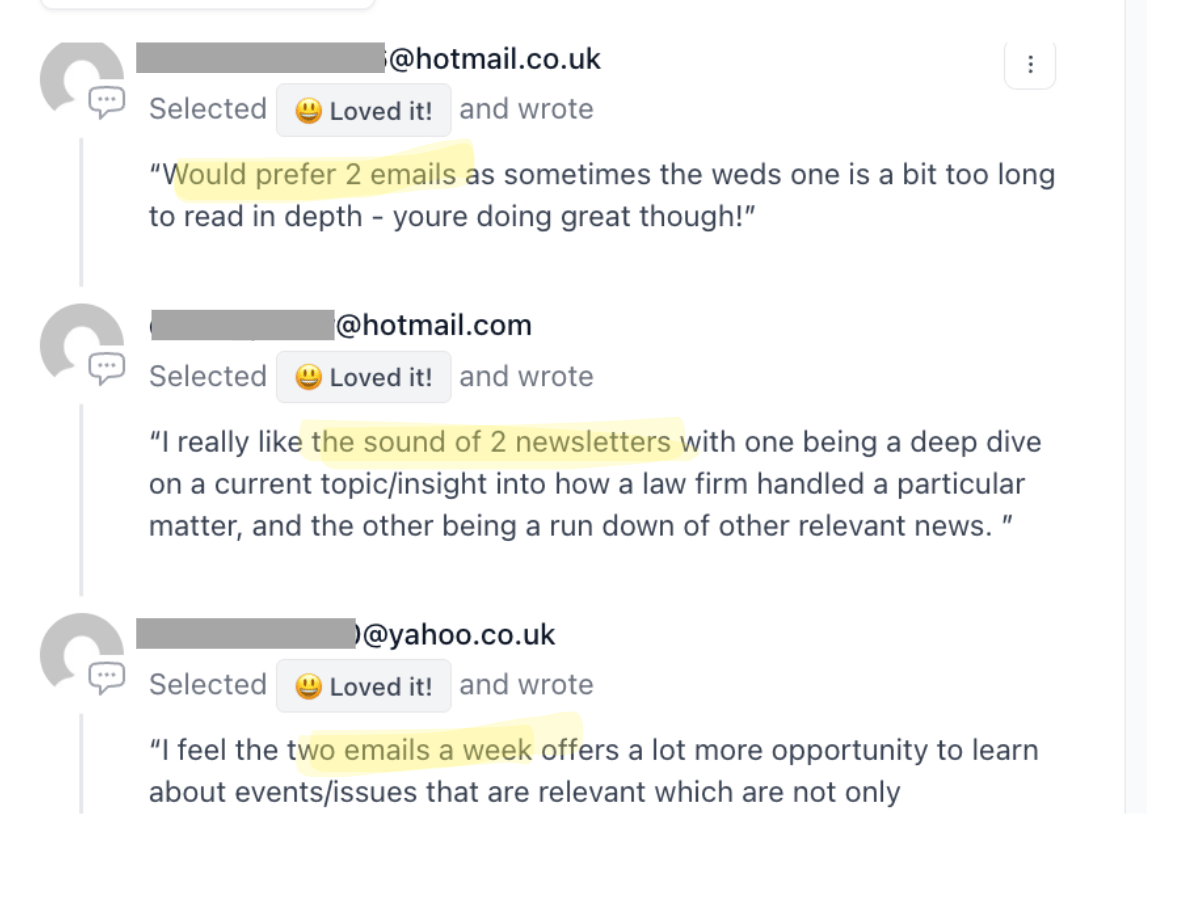
Some of the replies I got 👆️
So, from later this year (probably near September) we'll be trialling this split.
A deep dive on one story every Wednesday, and
A weekly news round-up on Fridays.
Hopefully that’ll mean each one's easier to read through, without us having to cut the most useful content that you should know.
As always, I want to make this as useful as possible for you – so keep the feedback coming each week. There's a poll at the bottom and I respond to every single response.
– Idin
P.S. Today’s story is a bit different from usual (it’s about how a case works procedurally). Let me know what you think.

FEATURED REPORT 📰
⚖️ Why Vodafone's £85 million lawsuit might end before it starts

What’s going on here?
Vodafone, the telecoms company, is being sued by 62 current and former franchisees for £85 million.
🤔 What is a franchisee?
A franchisee is someone who runs their own business using another company's brand, systems and rules. Think about your local McDonald's – the person who owns that local branch isn't McDonald's itself, but they use the logo, the menu and the systems. Here, the claimants were doing the same thing with Vodafone-branded stores.
The dispute in this case is whether, despite being called franchisees, they were actually doing the work of commercial agents – selling Vodafone products and building up its customer base.
That matters because commercial agents have specific legal rights, including the right to a termination payment when their contract ends.
The claimants say they should have received one. They also say Vodafone made a series of unfair commission decisions while the agreements were running, plus caused smaller losses through alleged underpayments, charges and fines.
But this article isn't about who's right. It's about what happened at the first case management conference last month – where the court had to decide how to handle a claim of this size. Those decisions show you how civil procedure works in real life, which will help you understand how disputes actually play out in practice (plus you’ll need it for the SQE).
🤔 What is a case management conference?
A case management conference (CMC) is a hearing where the judge decides how a case will be run – setting timetables, identifying the key issues, and keeping things fair and proportionate. Think of it as the admin session before the real arguments begin.
This CMC took place in the Commercial Court – the part of the High Court that handles complex business disputes. Usually one judge is assigned to manage the case throughout, so there's continuity across what can be several CMCs before the case ever reaches trial.
One of the biggest decisions at the CMC was whether the case should be heard all at once, or split into two stages.
Why did the judge split the trial in two?
The default position under the Civil Procedure Rules (CPR) is that everything gets tried together in a single trial. But the court has power (under CPR 3.1) to order a split. And in a case this complex, there were strong reasons to do so.
The proposed split looked like this.
Trial 1 (liability): This would deal with the core issues common to all 62 claimants – whether, despite being called franchisees, they were really doing the work of commercial agents, whether Vodafone's commission decisions were unfair, and whether the alleged underpayments, charges and fines were lawful.
Trial 2 (damages): If Vodafone was found liable, the next question would be how much each of the 62 claimants should receive individually.
The judge weighed several factors before deciding to split the trial into two. There were two factors that stood out.
⚖️ It could end the case early: If Vodafone wins on liability at Trial 1, there may be no need for Trial 2 at all. Even a partial win could make Trial 2 much smaller – saving time, cost and expert evidence. It would also mean the parties might never need to instruct forensic accountancy experts, whose job would otherwise be to calculate each claimant's individual financial loss.
🤝 It helps settlement: Once Trial 1 resolves the key legal principles, both sides know where they stand – and that clarity makes settlement more likely. A single trial covering all issues for 62 claimants would consume so much time and attention that meaningful negotiation becomes almost impossible.
How did the judge decide to manage 62 people’s cases?
Hearing full evidence from 62 claimants would be enormously expensive and time-consuming. So the court used a technique called sampling. This is when you select a smaller, representative group to stand in for everyone.
This works here because all 62 franchise agreements were nearly identical: Vodafone designed one franchise model and used something similar with everyone. That means the core question (what was the relationship between a franchisee and Vodafone?) is essentially the same regardless of which claimant you're looking at.
The judge ordered each side to pick eight claimants whose experiences best support their version of events. Together, those 16 sample claimants will give the judge a full picture of the franchise model across different store sizes, locations and trading volumes.
The remaining claimants can then use those outcomes as a benchmark to negotiate their own settlements – meaning that in a multi-party action like this, the vast majority never need their own full trial at all.
💡 The four main types of group litigation in the UK
→ Multi-party action: This is the simplest form. Each claimant opts in as a named party and they litigate together in one set of proceedings. That's what this Vodafone case is.
→ Representative action: One or more people bring a claim on behalf of others who share the same interest – so not everyone needs to be named individually.
→ Group Litigation Order (GLO): This is more formal. The court makes a specific order managing related claims as a group, with a shared register of claimants and common issues binding on everyone. The judge noted that no GLO had been requested here, even though one might have been appropriate.
→ CAT collective action: This is the closest thing to an American class action. It’s only available for competition law claims, and members can be automatically included unless they opt out – though opt-in versions also exist.
Which law firms are involved?
The claimants are split evenly between two firms, with Knights and Bird & Bird, each representing 31 claimants. Vodafone is being represented by TLT.
Why are the claimants represented by two sets of lawyers?
Having two law firms represent the same side isn't normal. It usually means the other side has to read and respond to twice the correspondence, attend twice the meetings, and deal with twice the admin – all at extra cost. Under English civil procedure, co-claimants in the same proceedings must share one legal representative unless the court specifically orders otherwise.
Although the claimants are formally split between the two firms, the case is being run together – both firms use the same barristers and divide the work between them.
There was also an issue with the appointment of one of the law firms. Bird & Bird was added the day after proceedings were served. When Vodafone flagged the irregularity, the claimants ignored it for 15 months – only applying for the court's approval eight days before the CMC.
Despite this, the judge allowed it for two reasons.
⚖️ Access to justice: Knights handles the bulk of the work at lower hourly rates, while Bird & Bird brings specialist expertise where needed. Without this arrangement, the claimants said they couldn't afford adequate representation through to trial.
⏳ The case was too far advanced to unwind: The parties had already conducted fifteen months of extensive negotiations. Starting from scratch with one firm would cause more disruption than just continuing with two.
The judge issued the claimants a warning that this decision was entirely fact-specific and shouldn't be treated as a green light for future cases. He then ordered the claimants to pay Vodafone's costs for this – meaning Vodafone recovered the £17,900 it spent dealing with the two-firm issue.
How can you use this in your applications?
Here are some ways you can use the insights from this story in your law firm applications.
Insight | Why it’s important | How to use it in your applications |
|---|---|---|
Procedure can be just as decisive as the law itself | Splitting this trial meant that if Vodafone wins on liability, almost the entire £85 million claim disappears without Trial 2. Procedural structure changes the economics of litigation – and creates powerful pressure to settle. | If you're interested in disputes work, discuss the procedural side of it. Talk about how structuring litigation strategically – deciding what gets tried, when, and in what order – can shape the outcome before anyone sets foot in a courtroom. That shows you understand what commercial litigation actually involves. |
Procedural mistakes have real financial consequences | The claimants ignored a known irregularity for 15 months and filed their application eight days before the CMC hearing. The result was a £17,900 costs order and a judicial warning on the record. Courts notice (and penalise) a lack of discipline. | If an application asks about your attention to detail or time management, you can ground those skills in reality by referencing how procedural errors in litigation directly cost clients money. It's not abstract – missing a deadline or filing a sloppy application has a price tag attached. That's why these skills matter in practice. |
Litigation is as much about cooperation as it is about conflict | Vodafone didn’t oppose the application for the two-firm arrangement. Once a workable proposal had emerged, it adopted a neutral stance, instead. The judge described that approach as responsible and helpful, which mattered when he later decided both the application and costs. | In a case study or assessment centre, if you're advising a client on how to respond to an opponent's position, don't default to opposing everything. Consider whether a cooperative stance – perhaps with conditions attached – might achieve a better outcome. Sometimes the smartest move isn't to fight. |
Smart case management makes group litigation viable | Sampling meant 62 claimants could be represented by just 16, keeping costs proportionate while still giving the judge a full picture. Without tools like this, multi-party commercial disputes would be out of reach for most claimants. | If you're applying to a firm with a group litigation or class actions practice, discussing how cases like this are managed – not just argued – shows commercial maturity. Firms increasingly use technology to handle evidence across large claimant groups, and showing you understand the operational side of running these cases, not just the law, sets you apart. |

TOGETHER WITH WOMBLE BOND DICKINSON*
3 things firms actually notice during your placement scheme

Work placements are one of the best ways to experience life inside a law firm and understand how lawyers work in practice.
We asked the Early Talent team at Womble Bond Dickinson for their top three tips for making the most of a placement:
💬 Engage actively with the firm. Introduce yourself to people across the firm (not just your supervisor), and ask thoughtful questions. Join conversations and observe how people work day-to-day. Placement weeks are designed to give you meaningful exposure, so make the most of it!
📚 Be prepared before you arrive. Read any pre-placement materials carefully, diarise key sessions and interviews, and know what you need for each day. Engage with any insight sessions the firm offers beforehand – these are designed to help you get the most out of your placement.
🧠 Treat every interaction as part of the assessment. Placement weeks are often the final stage of the training contract process. You’re assessed not only on your work, but also on how you communicate, approach tasks, and operate in a professional environment across the week. Show genuine enthusiasm, a positive energy, and a willingness to learn!
You can apply this advice at any firm placement or vacation scheme – but if you want to experience life at Womble Bond Dickinson, click the link below.
*This is sponsored content
IN OTHER NEWS 🗞
🏠 Rightmove is facing a £1.5 billion lawsuit over its estate agent fees. The claim – brought in the Competition Appeal Tribunal – accuses the property portal of abusing its dominant market position by charging estate agents excessive subscription fees. Over 250 estate agencies have expressed support since the action was first announced. This collective action claim is funded by Innsworth Capital (a litigation funder), with legal support from Scott+Scott.
🚀 SpaceX has filed to go public in what could be the biggest IPO in history. The company is reportedly targeting a valuation of roughly $1.75 trillion and looking to raise about $75 billion – dwarfing Saudi Aramco's $29 billion listing in 2019. The IPO is expected in June and comes days after Nasdaq (a stock exchange in the US) changed its rules in ways that could fast-track large newly listed companies into the Nasdaq 100. Gibson Dunn is advising SpaceX, with Davis Polk acting for the underwriting banks.
🎓 Perkins Coie has launched a virtual vacation scheme for students from low-opportunity backgrounds. The 45-hour programme was built with social mobility platform Zero Gravity and (my pal) Mike from BeSavvy. The scheme uses AI simulations to replicate the experience of an in-person scheme – including email tasks, voice exercises and assessment centre scenarios. It won't lead directly to training contract offers, but the firm says it will consider candidates' engagement as part of its broader recruitment. If you’re interested, you can sign up here.
AROUND THE WEB 🌐
🔤 Spellbound: Find the right path through a grid of letters to spell the hidden word in this satisfying little puzzle game
🕰️ Time-travel: This interactive timeline lets you scroll from the Big Bang to the present day and explore every major event in history
🍫 Mega: Cadbury unveiled a 70cm-tall, 55kg version of its classic Mini Egg – 17,000 times heavier than the original and now on display at Cadbury World in Birmingham 👇️


STUFF THAT MIGHT HELP YOU 👌
💻️ Free application advice: Check out my YouTube channel for actionable tips and an insight into the lifestyle of a commercial lawyer in London.
📁 Law firm application bank: A growing library of real, verified successful applications for training contracts and vacation schemes. Helpful if you want to learn from others who answered the same questions you’re stuck on.
📝 Write winning law firm applications: A practical course to help you write clearer applications, faster. Avoid common mistakes, learn how to structure answers properly, and get lifetime access to future updates. Try it for 14 days, risk free.
How did you find today's newsletter? |