- LittleLaw
- Posts
- This week's news roundup
This week's news roundup

Idin Sabahipour
March 27, 2026

Together with

Table of Contents

EDITOR’S RAMBLE 🗣
Happy Friday!
Usually, we post on Wednesdays. But I wanted to test something new (and get your thoughts).
Option 1 – Two shorter newsletters
Here’s the new idea.
We could have a mid-week edition, which goes deep on one story – a long explainer of one story and how to use it in your applications.
Then this one lands on Fridays and covers the other stories you need to know (with more context than we have in the current newsletter).
Option 2 – One long newsletter
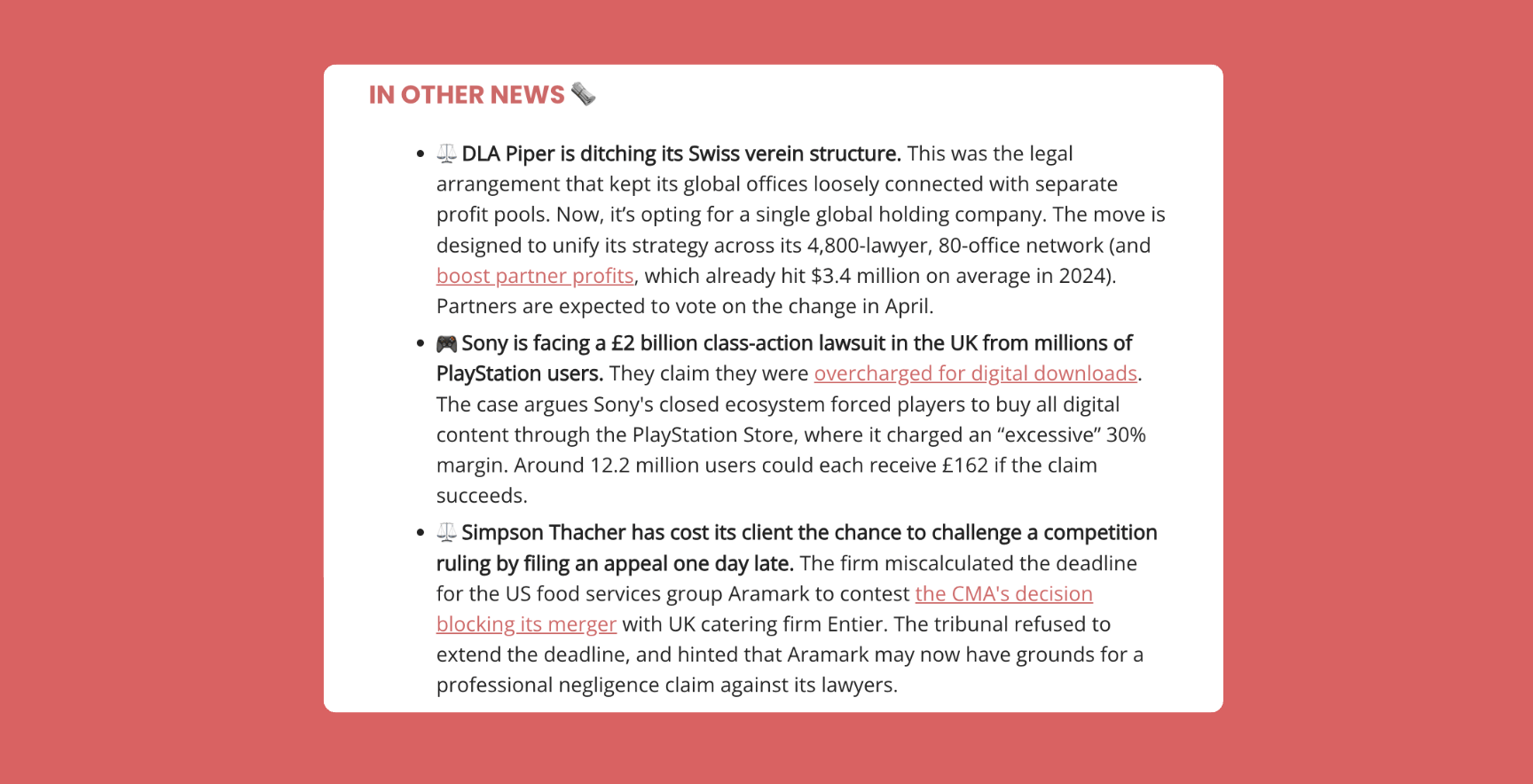
The alternative is we keep doing what we usually do – one newsletter, which includes one main story, plus a lighter "In other news" section that briefly goes over other news stories.
That looks like this 👇️
What do you think? Both have trade-offs.
Two newsletters means more depth, but also two emails in your inbox.
One newsletter keeps things tidy, but you get less on the stories that don't make the lead.
Instead of me guessing which you prefer, I thought I’d ask.
So, vote in this poll and share your reasons after you vote. It’ll take 4 seconds but will actually shape what we do next.
– Idin

TOGETHER WITH BARBRI SQE* 🤝
What if you could think like a solicitor in just 1-2 hours?

That’s exactly what this free programme from BARBRI is designed to do.
The Legal Skills for Aspiring Solicitors simulation puts you in the role of a trainee – and shows you how lawyers actually think, decide and solve problems.
In just 1-2 hours, you’ll:
Build legal reasoning and SQE-style thinking
Practise professional judgement and ethical decisions
Complete real-world tasks lawyers deal with
Earn a certificate for your CV and LinkedIn
It’s completely free, self-paced, and already has 850+ five-star reviews.
It’s a simple way to stand out early.
* This is sponsored content

THIS WEEK’S NEWS ROUNDUP 🗞️
📰 Freshfields and Slaughter and May advise on the £300 million Economist sale
What happened?
The Economist (one of the world's most influential news magazines) is changing hands for only the third time in its 183-year history, with Canadian billionaire Stephen Smith buying a 26.9% stake for around £300 million. This is only the third significant ownership shake-up in its 183-year history.
Freshfields is advising the seller, and Slaughter and May is acting for the buyer.
Why should you care?
This deal has an extra layer of complexity.
The Economist has a rule that no single shareholder can control more than 20% of the voting rights, no matter how big their ownership stake is. So even though Smith is buying 26.9% of the company, he won't have the voting power you'd normally expect to come with that.
On top of that, a group of independent trustees has to sign off on any ownership change – their job is to make sure the magazine stays editorially independent, whoever owns it. That's unusual in an M&A deal but it’s important for a business in a sensitive industry, like media.
It's also a good example of how firms build expertise in specific sectors to win repeat work. Freshfields recently advised Axel Springer on its £575 million acquisition of The Telegraph, and Slaughter and May acted for DMGT on its own (unsuccessful) bid for the newspaper.
In interviews, you can use this deal to explain why media company ownership is different to other M&A deals – and how rules designed to protect things like editorial independence can add a whole extra layer of work for the lawyers involved.
🌍️ Vinson & Elkins and Reed Smith have opened new offices
What happened?
Vinson & Elkins – a US law firm best known for energy work – has opened an office in Brussels (its first office in Continental Europe). It’s being led by a hire from Hogan Lovells with a background in merger control and EU antitrust (competition) investigations.
Meanwhile, Reed Smith has launched a new office in Boston, focused on private equity, M&A and fund formation. It's the firm's fourth new office in just 14 months.
Why should you care?
Law firms expand for the same reason other businesses do: to get closer to clients and the work. Brussels makes sense for antitrust – it's where the EU's competition regulator sits, and firms need people on the ground to handle investigations and merger filings.
Boston makes sense for private equity – the city has become a hub for private capital, with Freshfields, Paul Hastings and Simpson Thacher all opening there in the past two years.
In interviews, you can talk about how law firm strategy follows the work they do – new office openings signal where a firm expects future growth to come from.
Read more (Global Legal Post - Vinson & Elkins and Reed Smith)

🥤 Freshfields and Pinsent Masons lead as Huel sold to Danone in €1 billion deal
What happened?
French food giant Danone has agreed to buy UK nutrition brand Huel for €1 billion.
Freshfields is advising Danone, and Pinsent Masons is acting for Huel, its founder Julian Hearn and its investors. Hearn is reportedly set to make around £400 million from the sale.
Founded in 2015, Huel grew from a direct-to-consumer protein powder brand into a business with £250 million in annual revenue and distribution across more than 25,000 stores globally.
Why should you care?
This deal is a good example of a private company exit – where founders and early investors cash out after years of building value.
It also shows how firms build long-term client relationships: Pinsent Masons has advised Huel since 2018, guiding it through fundraising rounds before eventually leading the sale process. That kind of continuity is exactly what growing companies look for in a law firm. It's also why law firms like to work with early-stage companies. These businesses don't often have the funds to pay huge legal fees, but as they grow, that can change.
The deal involved a range of practice areas on both sides – corporate, tax, employment, IP and competition – which is worth noting if you want to talk about how major transactions rarely sit with just one team.
In interviews, you can use this deal to talk about the lifecycle of a startup from VC-backed growth to a big exit, and the different types of legal work that arise at each stage.
⚖️ Iran war prompts British lawyers in the UAE to reconsider
What happened?
There are an estimated 700 English-qualified solicitors practising in the UAE.
Since US-Israeli strikes on Iran began in late February, Iranian retaliatory drone and missile attacks have hit targets in the UAE including near Dubai's International Financial Centre.
Legal recruiters are now reporting a surge in enquiries from lawyers in the area considering returning to the UK or US.
Why should you care?
The Gulf has become a serious destination for UK lawyers over the past decade. The draw is real: no personal income tax, a booming market in private wealth, real estate and sovereign wealth fund work, and firms increasingly needing boots on the ground to compete for regional mandates (some UK firms have training contracts there too).
But international legal careers can come with geopolitical risk attached. As one recruiter put it, partners and associates are "monitoring events carefully" at the moment.
The longer-term question is whether the conflict changes how businesses and law firms think about the Gulf as a base. The damage isn't just what's happening now – this war is also impacting future decisions: where to open a regional HQ, where to expand a fund, where to launch a new trainee secondment.
In interviews, you can use this story to talk about how geopolitical events reshape where capital flows, and where businesses (and their staff) want to be.

STUFF THAT MIGHT HELP YOU 👌
💻️ Free application advice: Check out my YouTube channel for actionable tips and an insight into the lifestyle of a commercial lawyer in London.
📁 Law firm application bank: A growing library of real, verified successful applications for training contracts and vacation schemes. Helpful if you want to learn from others who answered the same questions you’re stuck on.
📝 Write winning law firm applications: A practical course to help you write clearer applications, faster. Avoid common mistakes, learn how to structure answers properly, and get lifetime access to future updates. Try it for 14 days, risk-free.
How did you find today's newsletter? |