- LittleLaw
- Posts
- 🚗 The £9.1 billion car finance scheme nobody likes
🚗 The £9.1 billion car finance scheme nobody likes


Idin Sabahipour & Ahad Rahim
April 29, 2026

Together with

Table of Contents
If you take just one thing from this email...
For 17 years, UK car dealers were paid hidden commissions by lenders for steering drivers into more expensive loans. The FCA is now forcing those lenders to pay £9.1 billion in compensation.
Some of the biggest lenders think the FCA's payout formula goes further than the law actually allows, but they aren’t going to court to challenge it. Fighting millions of individual cases would cost more than just paying the bill.
Sometimes the strongest legal argument isn't the right commercial move, and certainty is worth more than a fight (even if you'd win).

EDITOR’S RAMBLE 🗣
I asked AI whether I should walk or drive to a car wash 50 metres away. AI told me to walk. It's only 50 metres, that's a 30-second stroll.
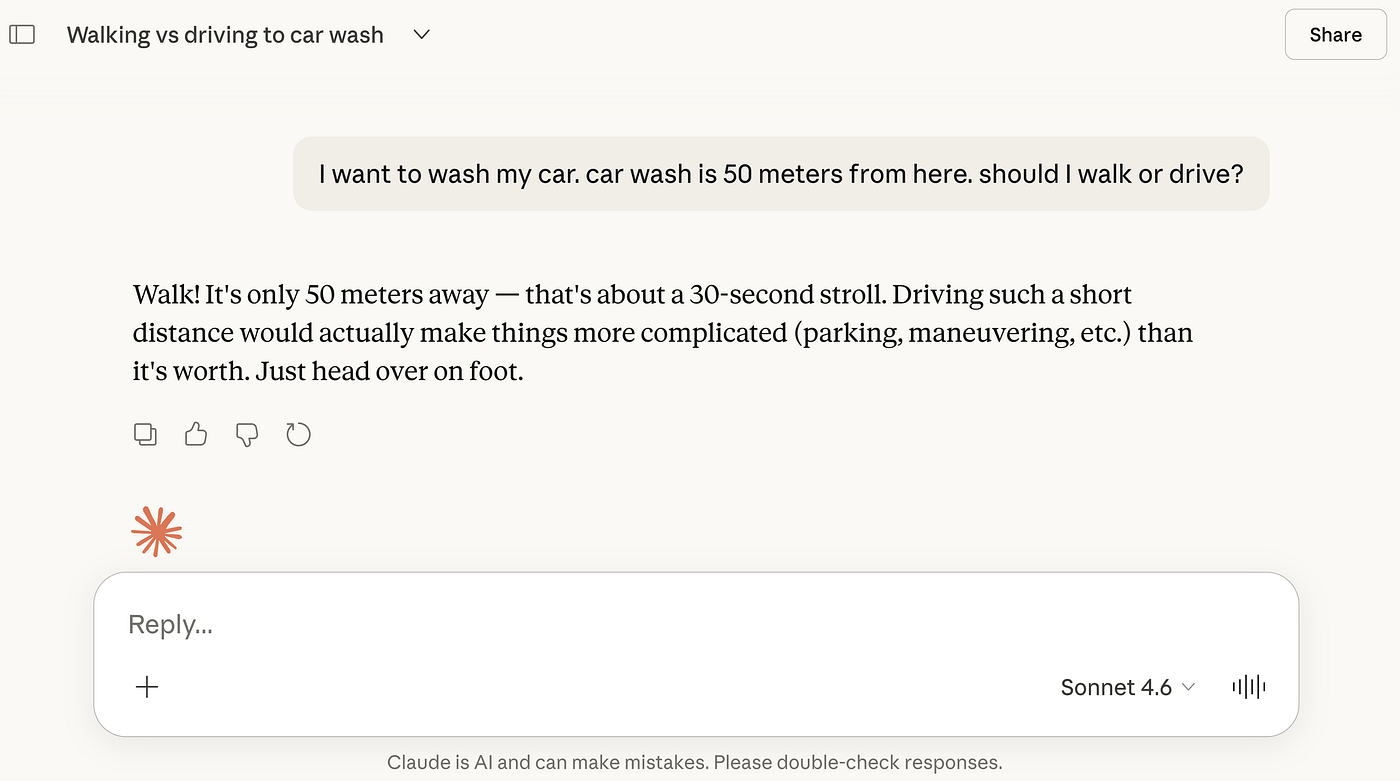
The thing is – you need the car to wash the car.
This “AI test” went round the internet a few weeks ago. I tested it again this week and the AI sometimes gets it right now (these things move fast).
But it's a useful reminder for any aspiring lawyer: AI is better than you at loads of things. It can hold huge amounts of context in its head and never forget a detail. It can draft, summarise and research in seconds – what would have taken you days.
But it's also worse than you at some things that you’d find easy.
Which brings me to Sullivan & Cromwell.
One of the most prestigious firms in the world has just admitted to a US bankruptcy court that an emergency motion it filed contained over 40 inaccurate citations – some of them AI hallucinations, where the tool invented cases that don't exist.

AI use, and its risks, comes up a lot during the law firm application process.
So here's a ready-made structure if you're ever asked about it.
Step 1: Acknowledging the upside – AI is a powerful tool that's already changing how lawyers work. Law firms are using it already.
Step 2: Point out the risks. It has known issues, including hallucinations which can be fatal for law firms. Use the Sullivan & Cromwell case as your example – an elite firm filed AI-generated citations that turned out to be fake.
Step 3: Land the point. The lesson isn't that AI shouldn't be used. It's that lawyers need to verify outputs, not just trust them.
And here's something worth remembering when you walk into that interview.
Most of you reading this have been exposed to AI for a long time now. Maybe you had it throughout university – used it for essays, revision, problem questions, job applications. You already know where it's strong and where it falls over – probably better than the partner across the table, who's learning it on the job.
If it comes up, talk about it confidently (and back yourself).
– Idin

FEATURED REPORT 📰
🚗 The £9.1 billion car finance scheme nobody likes

What’s going on here?
The Financial Conduct Authority (FCA) has built a £9.1 billion redress scheme for 12 million UK drivers who paid hidden commissions on their car loans. This week, the 28-day window to legally challenge the scheme expired.
🤔 What’s a redress scheme?
The FCA is the UK's financial regulator. Under s.404 of the Financial Services and Markets Act 2000, it can set up a compensation programme called a “redress scheme” when widespread regulatory failure in an industry (like motor finance) has caused consumers to suffer loss.
Consumer Voice, a consumer rights group, got its challenge in just before the deadline – arguing the scheme doesn't pay drivers enough. Lenders are unhappy too, but for the opposite reason.
What was the problem?
For 17 years (2007–2024), lenders paid commissions to UK car dealers on every financed deal.
🤔 How does dealer commission work?
Most people don't pay for a new car up front. They go to a dealer, pick a car, and the dealer arranges a loan with a lender – usually a bank or specialist car finance company. The lender pays the dealer, and the customer drives off, repaying the lender in monthly instalments.
The dealer introduces the customer to the lender and gets paid a commission for doing so – like a finder's fee.
Dealers had a list of lenders to choose from. But they didn't pick them impartially – they steered customers (pun intended) toward whichever lender paid them the biggest commission.
Lenders funded those commissions by charging customers higher interest rates to begin with – so the bigger the dealer's kickback, the more expensive the loan.
This was just how car finance worked. Around 40% of deals involved a discretionary commission – where the dealer profited directly from charging a higher rate – and 99% involved a commission payment of some kind.
Then in August 2025, the question hit the Supreme Court: was this arrangement lawful?
What did the UK Supreme Court say?
The Supreme Court ruled that hidden commission arrangements could be unlawful – and where they were, a court could rewrite or unwind the loan – but only if it found the relationship "unfair" under s.140A of the Consumer Credit Act 1974.
It said there isn't a clear test. Instead, it's a balancing exercise across six factors.
⚖️ How big was the commission compared to what the customer was paying to borrow?
📑 Was the commission tied to the interest rate (so the dealer profited from charging the customer more)?
👤 Was the customer commercially savvy, or a first-time buyer with no credit experience?
📢 Did the customer know the commission existed, and how much it was?
🚫 How well did the dealer stick to the conduct rules?
🤝 Did the dealer have a hidden arrangement with the lender (like a promise to send them business first) that the customer didn't know about?
These factors have to be balanced case by case. Every claim is fact-specific, every claim needs its own court hearing – and there are 12 million of them.
Instead of letting the courts drown in claims, the FCA chose something faster: an industry-wide redress scheme.
How does the FCA scheme work?
If you took out a car loan between 2007 and 2024, your lender will check whether you qualify and write to you. If you do, they'll send a compensation offer. You can take it, or sue your lender in court – but not both.
Lenders pay for the scheme themselves, and the FCA sets the rules. There are two important constraints.
The cap on the FCA. The FCA can't invent new rules about what counts as compensation – the scheme can only pay out what a court would have.
The cap on customers. Customers who pick the court route lose access to the scheme entirely. If courts stayed open as a fallback, lenders would face uncertainty for years and the scheme wouldn't deliver the speed it was designed for.
The scheme hasn’t gone unchallenged – both lenders and consumer groups have issues with it.
Why don’t lenders like it?
Most customers won't get their full commission refunded. Instead, they get a payout calculated as an average of two numbers:
1️⃣ How much they were probably overcharged on interest, and
2️⃣ The commission the lender paid the dealer (plus a bit of interest).
Add them together, divide by 2, and that's what the customer gets.
Lloyds, one of the UK's biggest motor finance lenders, says the formula is broken. Using the formula, a customer could get back more than the dealer ever earned in commission – breaking the rule that the FCA can't pay out more than a court would have done.
🤔 Why aren’t lenders challenging the scheme?
Going to court is more expensive than the scheme.
Without the scheme, lenders would face millions of individual cases from drivers, costing lenders more than £6 billion in operational costs alone – on top of whatever compensation a court ordered.
The scheme is the cheaper (but unhappy) ending for them. Lenders take the certainty of a known bill over a fight they might win on the law but lose on cost.
Why don’t consumer groups like it?
To qualify, two thresholds must be met. The dealer's commission has to be at least 39% of the total cost of borrowing (the interest and fees on the loan), and at least 10% of the loan itself. If you fall below either, you’re out of the scheme.
Consumer groups argue the 39% threshold is wrong. The argument is easiest to see with an example.
Imagine two customers buying the same car from the same dealer with the same commission – but the second has worse credit and pays a higher interest rate.
Here's how the threshold treats them 👇
🟢 Customer A (good credit) | 🔴 Customer B (worse credit) | |
|---|---|---|
🚗 Price of the car | 🟰 Same | 🟰 Same |
💸 Dealer's commission | 🟰 Same | 🟰 Same |
📈 Interest paid | 🔻 Lower | 🔺 Higher |
🧾 Total cost of borrowing | 🔻 Lower | 🔺 Higher |
💸➗🧾 Commission as a slice of that total cost of borrowing | 🔼 Bigger slice | 🔽 Smaller slice |
⚖️ Above or below the 39% threshold? | ✅ Above – stays in | ❌ Below – falls out |
The result is upside down. The customer who paid more (and is more likely to be the kind of vulnerable buyer the scheme was meant to protect) is the one it excludes.
Consumer Voice – the group leading the challenge – says the threshold shuts out the exact customers who were hurt the most.
🤔 How is Consumer Voice challenging the scheme?
Normally, you can't challenge a regulator's decisions in court just because you disagree with them – courts give regulators a lot of room to set policy. But s.404D of the Financial Services and Markets Act 2000 carves out an exception for redress schemes – letting them be challenged at the Upper Tribunal (a judicial body that handles regulatory appeals). That’s the route Consumer Voice is using. This is the first s.404D challenge ever brought against an FCA scheme.
The catch is that Consumer Voice can't argue the compensation should be higher – that's a policy disagreement and the Tribunal would dismiss it. So the group has reframed its complaint as a legal failure. They're arguing the FCA capped the interest payout without properly weighing how that cap would hit customers – that’s a "failure to consider relevant matters" in legal terms.
Why should law firms care?
Whatever the Tribunal decides, the scheme has already triggered a scramble among law firms and claims management companies to capture a slice of that compensation money.
🤔 What's a claims management company?
A claims management company (CMC) handles compensation claims for a consumer in exchange for a cut of the payout – usually around 30%.
They're not law firms. They handle paperwork, chase the lender, and only sue if there's a chance of success.
💷 Court still pays better than the scheme. The scheme's average payout is £829, but a court win averages around £1,500. For the right cases, that gap is enough for a law firm or CMC to build a business pursuing the court route instead.
🪤 The SRA is watching. Some law firms (not just CMCs) have signed confused consumers up to multiple contracts at once. Those contracts can have exit fees meaning a consumer who wants to switch (or take the scheme money) gets billed thousands. The SRA (alongside the FCA, ICO and ASA) is cracking down on the worst behaviour. Firms doing motor finance work need to assume their conduct is being watched – not just by clients – but by their own regulator.
How can you use this in your applications?
Here are some ways you can use the insights from this story in your law firm applications.
Insight | Why it’s important | How to use it in your applications |
|---|---|---|
Certainty can be worth more than a fight (even if you'd win) | Lenders think the FCA's formula could pay customers more than the law allows. But they aren't challenging it – because fighting millions of cases in court would cost more than just paying the bill. Most clients weigh risk against cost. They'll often take a known bill over an open-ended fight they might win on the law but lose on cost. | A key skill in disputes work is advising clients when not to fight. In an interview or case study, showing you can weigh risk against reward – and explain the merits of settling for certainty – will set you apart from most applicants. |
Your duty is to your client, not your firm’s bank balance | A scheme payout averages £829, free and quick. A court win averages £1,500 – but takes years and costs the client 30% in fees. For most drivers, the scheme is the better deal, even though the court route would earn the law firm more. SRA Principle 7 puts it very clearly – a solicitor must act in the best interests of each client. | Keep this in mind for competency questions, or when explaining why you want to be a solicitor in interviews. Putting the client's interests above your own isn't just a skill – it's a professional requirement, and it's why clients trust solicitors with their matters in the first place. |

TOGETHER WITH SCL
What’s the easiest way to stay on top of tech, AI and law?

One option is joining the Society for Computers and Law (SCL).
They offer free student membership, giving you access to a specialist community focused on law, technology and AI – including speakers like Sue McLean (Partner, Bird & Bird), and Mark O'Conor (Partner, DLA Piper).
It’s less about “joining a society”, and more about learning directly from people already working in the space.
Here’s what you can get involved in:
Become a Student Ambassador and represent SCL at your university
Attend events and hear from lawyers working in tech and AI
Access mentoring and start building your network early
If you’re interested in how tech is shaping the legal industry, build your understanding alongside your studies.
IN OTHER NEWS 🗞
💻️ Freshfields has signed a deal with AI giant Anthropic to build legal AI tools together. The partnership gives the firm early access to future Anthropic models and builds on an existing rollout that already lets more than 5,700 Freshfields staff use Claude through the firm's internal AI platform. The two will work on contract review, due diligence, legal research and "agentic" systems that can handle multi-step tasks. The deal sits alongside Freshfields' existing Google partnership, doubling down on its strategy of using multiple AI providers rather than committing to one.
🏠 The Renters' Rights Act comes into force on 1 May. It’s one of the biggest shake-ups to housing law in history. The Act bans no-fault evictions, scraps fixed-term tenancies in favour of rolling agreements, ends rental bidding wars, and sets clearer rules on pets. Landlords will now have to rely on a s.8 notice to evict tenants, which requires stricter grounds like rent arrears or antisocial behaviour. Renters say it brings long-overdue security, while some landlords warn the extra rules are pushing them to sell up.
🇦🇪 Law firms in the UAE are calling staff back to the office (and not everyone's happy). US firms including Jones Day and Cleary Gottlieb are pushing lawyers to return to their Dubai and Abu Dhabi offices, months after asking them to work remotely during the US-Israeli conflict with Iran. Some lawyers are pushing back, referencing the fragile ceasefire and the costs of relocating again. To smooth things over, Cleary is covering relocation costs for staff returning to Abu Dhabi.

STUFF THAT MIGHT HELP YOU 👌
💻️ Free application advice: Check out my YouTube channel for actionable tips and an insight into the lifestyle of a commercial lawyer in London.
📁 Law firm application bank: A growing library of real, verified successful applications for training contracts and vacation schemes. Helpful if you want to learn from others who answered the same questions you’re stuck on.
📝 Write winning law firm applications: A practical course to help you write clearer applications, faster. Avoid common mistakes, learn how to structure answers properly, and get lifetime access to future updates. Try it for 14 days, risk free.
How did you find today's newsletter? |