- LittleLaw
- Posts
- 🌍 How to talk about what’s happening in Iran in your applications
🌍 How to talk about what’s happening in Iran in your applications

Idin Sabahipour
March 04, 2026

Together with

Table of Contents
If you take just one thing from this email...
When a war disrupts key routes and energy hubs, the legal impact is seen in contracts. Oil and gas can’t move, insurers cancel their cover, and companies start arguing over who pays for it. And it’s all based on the exact wording of contracts (like: force majeure, delivery, and insurance clauses).
Those commercial challenges have knock-on impacts on the UK economy, pushing up costs and supporting high interest rates. This then slows deals (so, less work for corporate and banking lawyers) but could result in more companies facing financial difficulties (more work for restructuring and insolvency lawyers).

EDITOR’S RAMBLE 🗣
I nearly didn't write about this topic this week.
I am Iranian. I have family in Tehran. The internet has been switched off there, so I haven't been able to reach my uncle. I heard he was safe a few days ago. But right now, I don't know much more.
When that's your reality, writing about the Iran conflict from a commercial perspective feels almost inappropriate. Like I'm reducing something devastating to a discussion about shipping contracts and oil prices.
I wasn't sure if I wanted to cover it at all. Part of me felt like the right thing to do was pick a different topic this week and leave the coverage to people who aren't personally involved.
But now I think that’s probably why I should write about it. Yes, I feel uncomfortable talking about the Strait of Hormuz closure while Tehran is being bombed. We tend to separate "commercial" stories from "human" stories, as if they're different, but they’re not.
When you reach your goal of becoming a commercial lawyer, your work will be impacted by geopolitical events. Whether you’re working in energy, trade, sanctions, disputes, insurance, or transactions. Then I think you should hold both of those realities at the same time. The commercial and the human. It’s not always convenient, and it’s definitely not always comfortable.
But I think it's important. Not because it'll make you a better lawyer, but having that empathy will make you a better person.
– Idin

FEATURED REPORT 📰
🌍 How to talk about what’s happening in Iran in your applications

What’s going on here?
Last Saturday (28 February), the US and Israel launched a joint military strike on Iran, killing Ali Khamenei (Iran’s supreme leader — the highest position in the country) and around 40 senior officials. Iran retaliated with missile and drone strikes of its own, hitting targets in the UAE, Qatar, Saudi Arabia, Kuwait, Bahrain, and Israel.
As of today, the conflict shows no sign of stopping, with Donald Trump saying the campaign could last five weeks or longer.
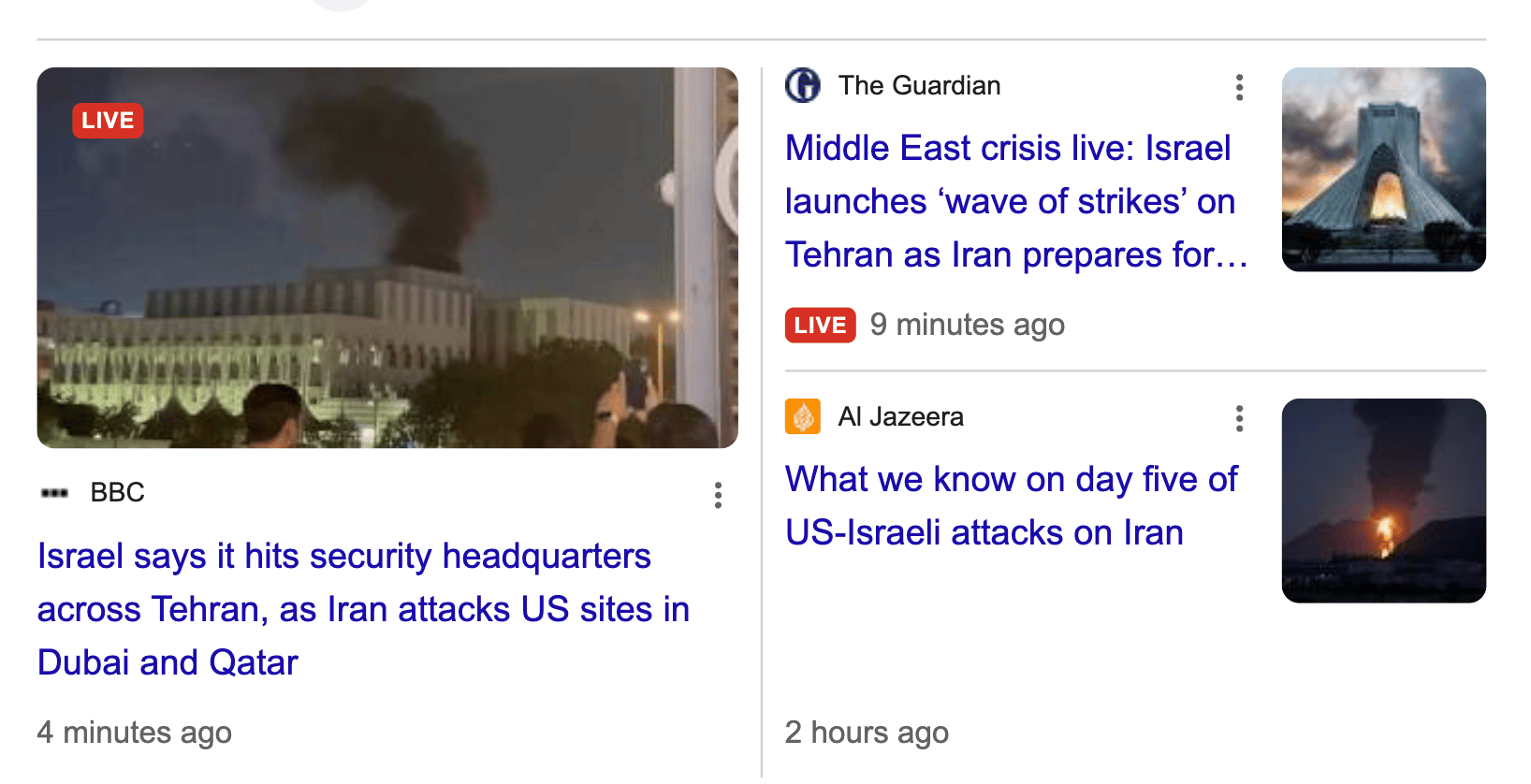
Here are the news updates as I’m writing this — it’s changing minute by minute
The wider commercial impacts of this story are huge. So, here’s what you need to know as an aspiring lawyer.
What are the commercial impacts of this story?
1. Oil prices are surging (because of a narrow stretch of water)
What’s going on?
Iran sits right next to the Strait of Hormuz — a narrow passage between the Persian Gulf and the open ocean. Around a fifth of the world's oil supply passes through it every day.

That makes it one of the most important chokepoints in the global economy.
🤔 What is a chokepoint?
It’s a narrow shipping route where huge volumes of traffic are forced through a small space. If it gets blocked, there's no easy alternative. Think of it like a motorway bottleneck (except this one carries 20 million barrels of oil a day).
Since the strikes began, Iran has warned ships not to pass through the Strait and claims to have destroyed three tankers. Shipping has almost completely stopped. Yesterday, Iraq (one of the world's biggest oil producers) started shutting down its largest oil fields simply because there aren't enough tankers willing to make the journey.
Why does this matter?
Oil prices jumped to around $85 a barrel this week — the highest since mid-2024.

OPEC+ (the group of major oil-producing nations) has promised to increase output, but more supply doesn't help much when the oil can't physically leave. Some analysts are predicting oil could hit $100-120 a barrel if the disruption continues.
🏢 What’s the impact on law firms?
This creates a lot of work for energy lawyers. When oil can't move, parties can't meet their obligations under their contracts.
Lawyers are advising oil producers, traders, and buyers on whether the closure of the Strait triggers “force majeure” clauses — these are provisions in contracts that excuse a party from delivering when an extraordinary event (like this) makes performance impossible.
Then there’s a question of liability. If your client signed a deal to deliver oil and now physically can't, who bears the cost? (Answer: it depends on the contract wording)
2. Europe's gas supply took a major hit
What’s going on?
Iranian retaliatory strikes hit Qatar's Ras Laffan Industrial City, home to the world's largest liquefied natural gas (LNG) export facility. QatarEnergy, the state energy company, has ceased production.
🤔 What is LNG?
Liquefied natural gas is natural gas that’s cooled to -160°C into liquid form so it can be shipped around the world in tankers. Countries that don’t have their own gas supply (like the UK) rely on LNG imports to heat homes and generate electricity.
Why does this matter?
Qatar supplies roughly 15% of Europe's LNG imports and nearly a quarter of China's. There is virtually no spare LNG capacity globally, so when Qatar goes offline, there's no easy replacement.
So, European gas prices surged over 90% in a single week. UK wholesale gas prices briefly hit 151p per therm (a level not seen since February 2023, after Russia's invasion of Ukraine).

If the disruption continues, analysts warn that Europe and Asia will end up competing aggressively for whatever LNG supply remains, pushing prices even higher. That feeds directly into household energy bills, business costs, and inflation.
🏢 What’s the impact on law firms?
This one’s very similar to the oil story — but the contracts are different. LNG is typically sold through long-term supply agreements rather than being bought and sold on the day.
Lawyers will be advising buyers who had deals with QatarEnergy on whether the shutdown counts as a force majeure event under their specific contract. If it does, the buyer then needs to source replacement gas on the open market (at a much higher price). The follow-up question is whether they can recover that extra cost from QatarEnergy, or through their business interruption insurance (again, the answer’s in the contract wording).

TOGETHER WITH BARBRI* 🤝
Got 4 minutes? It could save you £3,499

The Future Lawyer Survey 2026 is live — and it takes less time than your morning scroll.
In return, you could win a free SQE prep course worth up to £3,499. Also, every single person who completes the survey is guaranteed to get an SQE discount code.
And there’s more.
For every completed response, BARBRI will donate £1 to So They Can, helping fund education for children living in poverty.
Your feedback helps BARBRI build better SQE courses, clearer guidance and stronger support for aspiring solicitors.
* This is sponsored content
3. Insurers aren’t covering ships, so ships aren’t moving
What’s going on?
More than half of the world's largest maritime insurance firms have stopped covering war risks for ships entering the Persian Gulf. Seven members of the International Group of Protection and Indemnity Clubs (the London-based organisations that insure most of the world's shipping fleet) will automatically terminate cover if a vessel enters the Gulf.
This matters because ships can’t sail without insurance — it’s not optional. No insurer means no voyage, regardless of whether the captain is willing to go.
Why does this matter?
London covers around 80% of the world's war insurance business. The cost of insuring a vessel entering the Gulf has already jumped by 25-50%, and some insurers are adding blanket exclusions that withdraw cover entirely if a ship enters the affected zone. Trump has offered to have the US Navy escort tankers and provide government-backed insurance guarantees — but that doesn’t remove the risk. Sending warships through a contested strait during an active conflict could escalate things further.
🏢 What’s the impact on law firms?
Insurance lawyers in London will be dealing with this right now.
Claims are already coming in — at least four commercial vessels have been damaged, and major infrastructure (including Saudi Arabia's largest refinery) has been hit.
Lawyers are advising shipowners on whether their war-risk insurance policies cover these losses, which involves complex questions like:
→ Was the vessel inside a designated exclusion zone when it was hit?
→ Did the owner give adequate notice to insurers before entering the area?
On top of that, brokers and underwriters are redrafting policy wordings in real time as the conflict evolves.
4. This war is already hitting the UK economy
What’s going on?
The higher oil and gas prices mentioned don't just stay in the Gulf — they follow you home. UK wholesale gas prices surged 93% in a single week. Petrol now costs more, and energy bills are heading up too. When energy gets more expensive, so does everything else — businesses pass those higher costs on to customers.
This landed right on top of the Chancellor's Spring Statement yesterday. Rachel Reeves had hoped to deliver a quiet update. Instead, she was speaking while markets were falling fast, and borrowing costs were spiking.
🤔 What is the Spring Statement?
It's a yearly update where the Chancellor — the government’s finance minister — presents the latest economic forecasts and spending plans.
It's a smaller event than the Budget (in November), but markets still watch it closely because it signals where the economy is heading.
Why does this matter?
The Bank of England had been expected to cut interest rates — which would have made mortgages and borrowing cheaper.
Markets put the odds of an interest rate cut in March at around 86% before the conflict started. Now, that’s dropped to under 50%.
So, why does a war stop interest rate cuts? Well, central banks cut interest rates to boost a slowing economy. But they can't do that if inflation is rising at the same time — cutting rates would make inflation worse (because cutting rates → cheaper borrowing → more spending → prices get pushed up further).
The energy price spike is pushing inflation back up, which means the Bank of England may have to keep rates higher for longer, even though the economy is weakening. Economists call this "stagflation" — a combination of stagnant growth and high inflation (it's the worst of both worlds).
🏢 What’s the impact on law firms?
If interest rates stay higher for longer, borrowing gets more expensive — and that directly affects deal activity. Companies are less likely to take on debt to fund acquisitions, expansions, or new projects when the getting a loan costs more.
That means fewer transactions, which means less work for corporate, banking, and finance lawyers.
But on the other hand, restructuring and insolvency teams tend to get busier when the economy weakens — businesses that were already struggling may not survive another energy price shock.
IN OTHER NEWS 🗞
🎬 Paramount has won the bidding war to buy Warner Bros Discovery, beating Netflix. The winning bid was a massive $111 billion all-cash offer — one of the largest leveraged buyouts ever. The deal brings channels like HBO, CNN and the Harry Potter franchise under one roof. Paramount has also committed to paying a $7 billion "reverse breakup fee" if the deal collapses because regulators block it. Top US law firms are advising across the board, including Cravath and Latham & Watkins for Paramount, Wachtell and Debevoise for WBD, and Skadden for Netflix.
🍺 BrewDog, once valued at £2 billion, has been sold to US cannabis and alcohol group Tilray Brands for just £33 million. The craft beer giant entered administration on Monday, with 38 UK bars closing immediately and nearly 500 jobs lost. Worst of all for the thousands of everyday investors who bought shares through BrewDog's "Equity for Punks" crowdfunding scheme — they won't see a penny back. Proskauer is advising Tilray, and DLA Piper is acting for administrators AlixPartners.
⚖️ A federal judge in the US ruled that documents created using an AI chatbot aren't protected by attorney-client privilege — even if they’re later shared with a lawyer. In USA v Heppner, the judge found that using a public AI tool doesn't count as “communicating with a lawyer”, and the platform's privacy policy meant there was no reasonable expectation of confidentiality. The ruling doesn't bind UK courts directly. But the logic can transfer over — legal professional privilege here also requires confidentiality, so using a public AI tool to prep for a case could result in the same finding. (Shout out to Joseph J for sending in this story)
AROUND THE WEB 🌐
🎵 Cool: Add a single note to this shared music project across the whole internet
🎬 Watch: A combined ranking of the greatest films using scores from IMDb, Rotten Tomatoes, Metacritic, and more
🤖 Robots: A man trying to control his robot vacuum with a PS5 controller accidentally gained access to thousands of DJI vacuums worldwide (including their camera feeds)

STUFF THAT MIGHT HELP YOU 👌
💻️ Free application advice: Check out my YouTube channel for actionable tips and an insight into the lifestyle of a commercial lawyer in London.
📁 Law firm application bank: A growing library of real, verified successful applications for training contracts and vacation schemes. Helpful if you want to learn from others who answered the same questions you’re stuck on.
📝 Write winning law firm applications: A practical course to help you write clearer applications, faster. Avoid common mistakes, learn how to structure answers properly, and get lifetime access to future updates. Try it for 14 days, risk free.
How did you find today's newsletter? |