- LittleLaw
- Posts
- 💄 How lawyers helped a make-up brand raise £9 million
💄 How lawyers helped a make-up brand raise £9 million

Idin Sabahipour
March 18, 2026

Together with

Table of Contents
If you take just one thing from this email...
Before any private equity investor hands over money, lawyers run a thorough check on the business – called due diligence. They look at everything from contracts and data protection to who actually owns the brand's logos and content. The goal is simple: find the risks before the deal is done, and then decide how to manage them.

EDITOR’S RAMBLE 🗣
I think a lot of aspiring lawyers want to work in London because they assume the interesting deal work all happens there.
But this one didn't.
We partnered with the team from Womble Bond Dickinson for this week's newsletter – a £9 million private equity investment into the make-up brand VIEVE.
It was led by a partner in Leeds, with a managing associate and associate working out of Bristol.
And it's been a super interesting deal to learn about. My key takeaway is that due diligence on a founder-led consumer brand looks really different to due diligence on, say, an energy company – and this newsletter gets into exactly why.
Once you've read it, please could you complete this 2-second poll further down? I'd love to hear your thoughts (especially if it helped you understand WBD better).
Your comments are a huge help in us partnering with more firms (which means more insight for your applications).
– Idin

FEATURED REPORT 📰
💄 How lawyers helped a make-up brand raise £9 million

What’s going on here?
Piper Private Equity (Piper), a UK-based private equity firm, invested £7 million in VIEVE – the make-up brand founded by Scottish make-up artist Jamie Genevieve. The investment is part of a bigger £9 million funding round.
The plan is for the money to fund VIEVE’s international expansion, new retail partnerships and product development.
Womble Bond Dickinson (WBD) advised Piper on the investment.
What kind of deal is this?
When you hear about "private equity", you might think they buy a company outright. In fact, usually they take a majority stake – with the founders or management team keeping the remaining shares to align their interests with the private equity house to grow the business.
But even that’s not always the case.
Piper specialises in “growth capital”. That means sometimes it will take a minority stake in a business that’s already doing well and back it to grow faster.
🤔 What is a minority stake?
It's when an investor buys a share of a company, but not enough to take control (usually less than 50%). Often, the founders or management team will hold the remaining shares, and they’ll keep running things day to day.
In this case, Piper invested £7 million, with existing shareholders (like Venrex, Pembroke VCT and Active Partners) also putting money in as part of the same £9 million round.
What do lawyers check before a client invests in a company?
Before Piper made the investment in VIEVE, the lawyers at WBD checked over the business – this process is called due diligence.
🤔 What is due diligence?
It's the legal health check that happens before an investment completes. The investors’ lawyers go through the company's key documents to spot any risks.
Think of it like asking a mechanic to inspect a second-hand car before you buy it. You want to understand if there are any issues before you hand over the money.
On a deal like this, due diligence is really about working out where the value sits in the business – and whether anything could put that value at risk. For a consumer brand like VIEVE, that means looking closely at areas like:
🏢 Corporate structure: WBD's corporate team would have checked that VIEVE had the legal authority to issue the new shares the investor was receiving, and that existing shareholders' rights had been respected.
📦 Commercial contracts: Lawyers check things like key supply, manufacturing and distribution agreements. Are they properly signed? Are there any unusual or onerous terms? Could any termination rights be triggered by the investment?
🔐 Data protection: Consumer e-commerce brands rely heavily on customer data (for things like email lists and purchase history). WBD’s lawyers would have checked how the company handled that data in a way that complies with relevant laws (like UK GDPR). Any issues could lead to fines, so it's important to spot them early.
👥 Employment: WBD’s employment team would have reviewed things like employment contracts, consultancy arrangements, company policies and details of any past claims. They'd pay particular attention to key members of the management team, making sure they’re properly contracted and have incentives in place to keep them. For a founder-led brand like VIEVE, the success of the investment depends on the right people staying to grow the business.
💰 Finance: Lawyers typically check the company's existing financing arrangements – things like outstanding loans, guarantees or security interests. They need to confirm that none of these restrict the company from issuing new shares or taking on new investors. If they do, the company might need the lender's consent before the deal can complete.
🏠 Real estate: WBD's real estate team would have reviewed lease terms, rent obligations and repair liabilities for any properties the company operates – like VIEVE's store in Glasgow. Long-term lease commitments can affect profitability, and if part of Piper's investment is funding expansion into new locations, it needs to understand what the existing commitments look like first.
What happens when lawyers find a risk?
Due diligence almost always shows up “issues” – some risk is normal in any business.
The question then becomes, how do you treat that risk? Lawyers have a few different tools they can use.
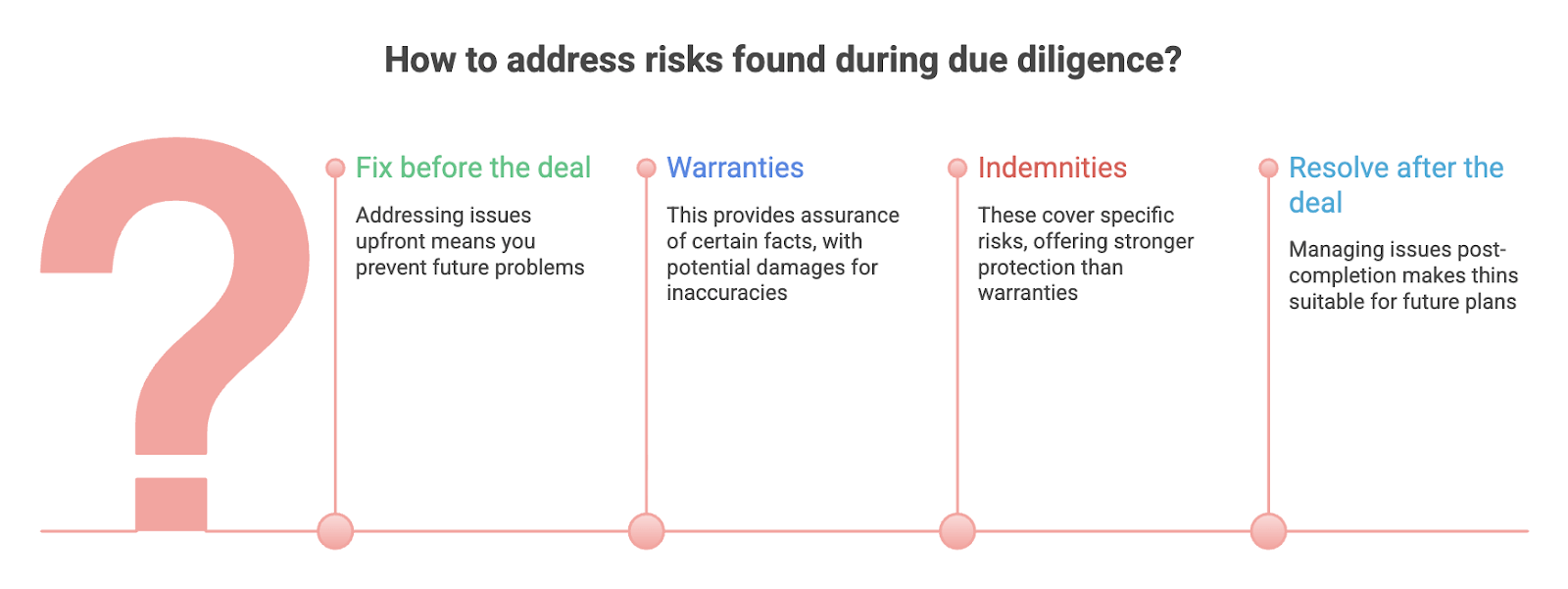
Option 1: Fixing things before the deal completes
Some issues can just be sorted out upfront. For example, if the investor’s lawyers find out an element of the company's IP isn't properly registered, they can require that to be fixed by the company before the deal’s completion.
That solves the problem before any money changes hands.
Option 2: Warranties
Warranties are statements in the contract made by the company (or key shareholders or members of its management team) confirming that certain things are true – for example, that:
“The company owns all its trade marks”, or
“That there's no ongoing litigation”.
If a warranty turns out to be wrong and the investor suffers a loss, they may be able to bring a claim against those giving the warranty.
🔍 Disclosure (the flip side of warranties)
Once you ask a company (or key shareholders or members of its management team) to give a warranty, that could prompt them to disclose a problem that would make that warranty untrue.
For example, say the company warrants that “it owns all of its key IP”. But then it reveals that a freelance photographer actually owns the rights to some images used across its website. That's a disclosure – the company is saying: "This warranty isn't quite true – here's why."
Once that issue’s been disclosed, the investor generally can't claim under the warranties for it. So disclosure protects those giving the warranties, while giving the investor more information about risks.
Option 3: Indemnities
Indemnities cover specific, known risks. Say a company has an unresolved issue with a manufacturer. The investor knows about the problem – but wants protection if it ends up costing money.
If the risk materialises, the company has to reimburse the investor for the actual cost. It’s a stronger protection than a warranty. That’s because, unlike a warranty, the investor doesn't have to prove how or why they suffered a loss – just that it happened and it cost them money.
Option 4: Resolving issues after the deal completes
Some issues are better dealt with after completion – for example, registering trade marks in new markets ahead of international expansion. These can be added to a post-completion action plan.
Why was IP a key focus on a deal like this?
For a founder-led consumer brand, intellectual property (or “IP”) can be the most valuable thing the company owns – so Piper needs to know it's properly protected.
™️ Trade marks: The brand name, logos and product lines need to be registered, owned by the company and protected in the right markets. For example, if VIEVE planned to expand into another country, it would register its trade marks there, so a competitor couldn’t use the name.
🤔 What is a trade mark?
A trade mark is a registered right that protects things like a brand name, logo or slogan. It stops other businesses from using something confusingly similar. If you've ever seen the ® symbol next to a brand name, that means it has a registered trade mark.
🎤 Founder image rights: VIEVE is closely tied to its founder Jamie Genevieve – she appears in campaigns, tutorials and across the brand's social channels. The lawyers need to check the company has clear, documented rights to use her name and likeness, usually through a licensing agreement. This gives investors like Piper confidence that a core part of the brand's value is properly secured.

📸 Content ownership: A lot of creative work – photography, video, design – gets produced by freelancers or agencies. Those contracts need to include an “IP assignment clause” so the ownership of those works gets transferred to the company.
What did junior lawyers actually do on this deal?
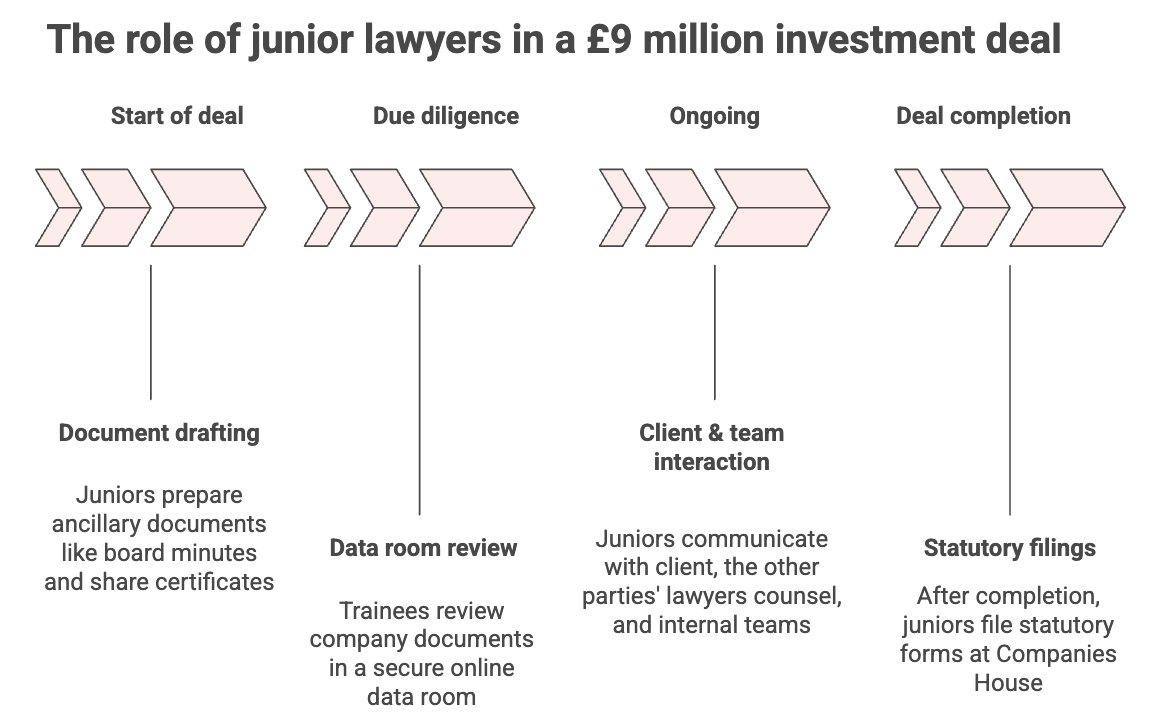
WBD's trainees and newly qualified lawyers were involved from start to finish.
Drafting and checking documents
Juniors were involved in preparing the ancillary documents needed for the deal – like board minutes, shareholder resolutions, share certificates and stock transfer forms. These sit alongside the main investment agreement (called a subscription and shareholders’ agreement).
Trainees also checked for consistency across the full suite of documents – making sure key terms were defined the same way throughout and that nothing contradicted itself.
Reviewing the data room
Remember the due diligence process? The way it looks in practice is that the company uploads all its key documents into a secure online platform called a data room (basically, a big Google Drive folder). Then the lawyers review them.
Trainees were involved in reviewing a lot of these documents, summarising the key points for the wider team and reporting any potential issues the client might want to be aware of.
Day-to-day communication
Trainees were able to communicate with internal teams at WBD – chasing outstanding documents, circulating updated drafts and resolving routine queries. On a fast-moving deal, this keeps things on track.
After completion
Once the deal closed, trainees prepared and filed statutory forms at Companies House – the public register of UK companies. This updates the public record to reflect the new shares and who owns them.
What can future lawyers learn from this?
For future commercial lawyers, here are three key lessons you can take from this transaction.
🧱 Due diligence isn't one-size-fits-all: What WBD's team checked on this deal was shaped by the type of business VIEVE is.
Founder image rights, trade mark registrations and customer data practices were important. On an energy deal, those areas might feature less – instead, the focus could be on planning permissions, environmental liabilities and government contracts.
Good lawyers tailor their approach to where the value actually sits in the business.
⚖️ Corporate teams lead, but everyone gets involved: WBD's corporate team drove and project-managed this deal. But their employment, IP, real estate and commercial lawyers all fed into the due diligence report and the final deal documents. A risk flagged by the employment team might end up as a warranty drafted by the corporate team.
Understanding how these areas connect is what makes a strong commercial lawyer.
🤝 Trainees get real responsibility early: WBD's trainees and NQs drafted ancillary documents, reviewed the data room, contributed to the due diligence report and coordinated across specialist teams.
That work isn't background support – it's what keeps a fast-moving deal on track, and it builds trust with senior lawyers and clients early on.
Did this newsletter help you learn more about the work WBD does?Please share a reason after you vote (it really helps us) |
Your responses are a huge help in us getting to do more with law firms.

IN OTHER NEWS 🗞
⚖️ DLA Piper is ditching its Swiss verein structure. This was the legal arrangement that kept its global offices loosely connected with separate profit pools. Now, it’s opting for a single global holding company. The move is designed to unify its strategy across its 4,800-lawyer, 80-office network (and boost partner profits, which already hit $3.4 million on average in 2024). Partners are expected to vote on the change in April.
🎮 Sony is facing a £2 billion class-action lawsuit in the UK from millions of PlayStation users. They claim they were overcharged for digital downloads. The case argues Sony's closed ecosystem forced players to buy all digital content through the PlayStation Store, where it charged an “excessive” 30% margin. Around 12.2 million users could each receive £162 if the claim succeeds.
⚖️ Simpson Thacher has cost its client the chance to challenge a competition ruling by filing an appeal one day late. The firm miscalculated the deadline for the US food services group Aramark to contest the CMA's decision blocking its merger with UK catering firm Entier. The tribunal refused to extend the deadline, and hinted that Aramark may now have grounds for a professional negligence claim against its lawyers.
AROUND THE WEB 🌐
🌍 Time: France spans 12 different timezones (the most of any country) thanks to its overseas territories — meanwhile, China uses just one timezone despite covering the width of five
📖 Wordy: The longest word in the English language is Pneumonoultramicroscopicsilicovolcanoconiosis (a lung disease caused by inhaling fine volcanic dust) — but there’s also a chemical name for a human protein which runs to 189,819 letters (here’s the 42-page PDF with the full name)
🗣️ Puzzle: This word game is where sudoku meets Scrabble meets Tetris

STUFF THAT MIGHT HELP YOU 👌
💻️ Free application advice: Check out my YouTube channel for actionable tips and an insight into the lifestyle of a commercial lawyer in London.
📁 Law firm application bank: A growing library of real, verified successful applications for training contracts and vacation schemes. Helpful if you want to learn from others who answered the same questions you’re stuck on.
📝 Write winning law firm applications: A practical course to help you write clearer applications, faster. Avoid common mistakes, learn how to structure answers properly, and get lifetime access to future updates. Try it for 14 days, risk free.
How did you find today's newsletter? |